Published On: 09/09/2026 Published By: RCM BILLING SERVICES
At ElCare Global Inc, we work with healthcare providers across the U.S. every day, and few things are as frustrating — or as costly — as a denied claim. Industry estimates suggest that anywhere from 5% to 10% of submitted claims are denied on the first pass, and each one costs practices time, staff hours, and delayed revenue. The good news: most denials are preventable with the right processes in place.
Here are five strategies that consistently help practices lower their denial rates and speed up reimbursement.
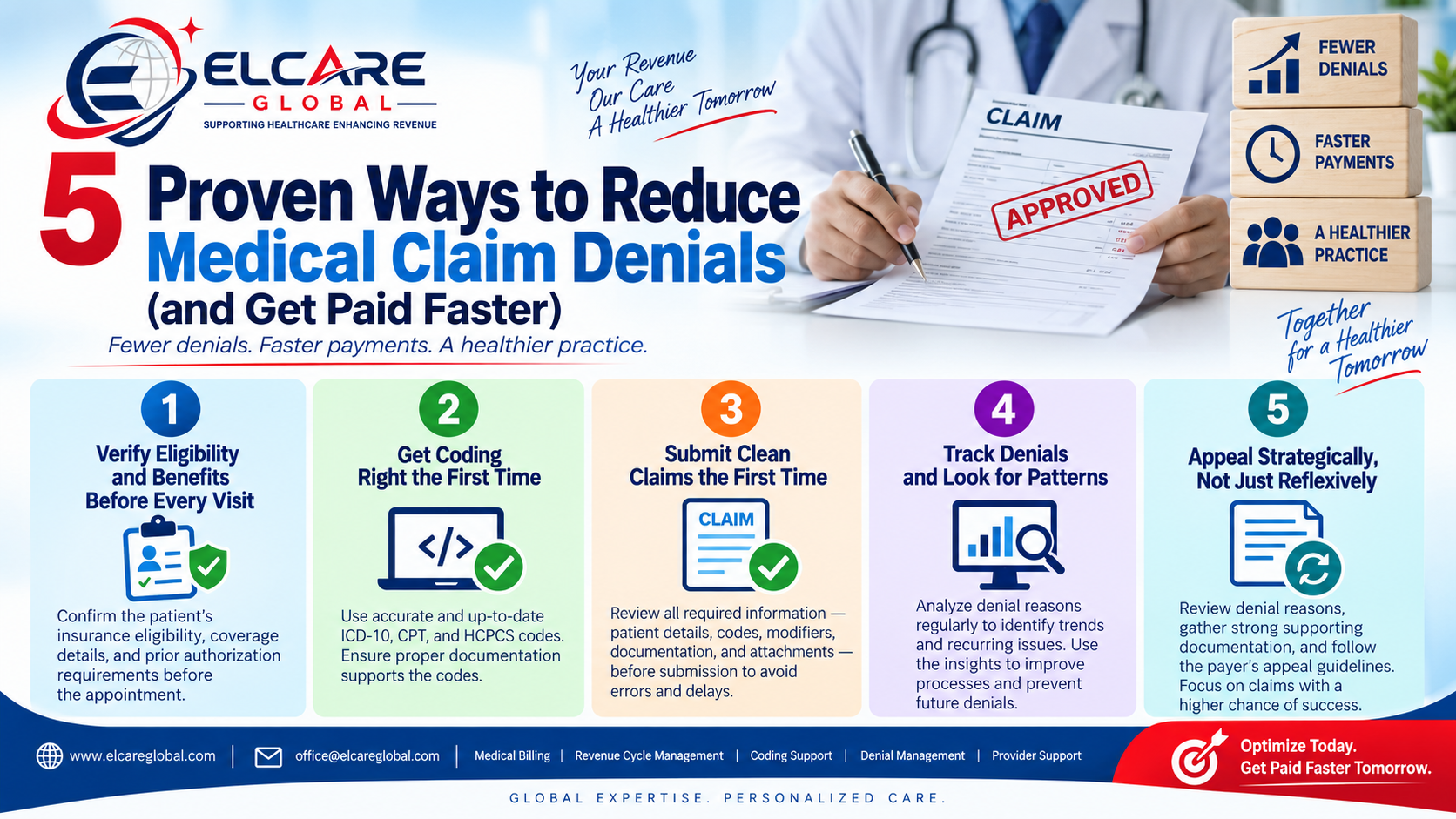
1.Verify Eligibility and Benefits Before Every Visit
A surprising number of denials trace back to something simple: the patient's coverage had lapsed, changed, or didn't include the service rendered. Real-time eligibility verification — done before the appointment, not after — catches these issues early and gives your front desk the chance to collect accurate copays or flag self-pay situations upfront.
2.Get Coding Right the First Time
Incorrect or outdated CPT, ICD-10, or HCPCS codes are one of the most common denial triggers. Coding accuracy isn't just about knowing the codes — it's about staying current as payer rules and code sets change year to year. Regular coder training, along with claim scrubbing software that flags mismatches before submission, can catch errors before they ever reach the payer.
3.Submit Clean Claims the First Time
A "clean claim" — one with no errors, missing information, or formatting issues — is far more likely to be paid on the first submission. This means double-checking patient demographics, provider NPI numbers, modifiers, and authorization numbers before the claim goes out the door. A strong claim-scrubbing process at this stage prevents the costly cycle of denial, correction, and resubmission.
4.Track Denials and Look for Patterns
Not all denials are created equal, and treating each one as an isolated incident means missing the bigger picture. Categorizing denials by reason — eligibility, authorization, coding, timely filing, medical necessity — reveals patterns. If a particular payer or code combination keeps triggering denials, that's a signal to fix the root cause upstream rather than resubmitting the same claim over and over.
5.Appeal Strategically, Not Just Reflexively
Not every denial is worth appealing, but many are — and appeals that are well-documented and filed promptly have a strong success rate. Having a standardized appeals workflow, with templates and documentation checklists ready to go, means your team can respond quickly within payer deadlines instead of scrambling.
The Bottom Line
Denial management isn't a one-time fix — it's an ongoing discipline built on accurate front-end data collection, careful coding, clean claim submission, and diligent follow-up. Practices that invest in these fundamentals see measurably faster reimbursement and healthier cash flow.
At ElCare Global Inc, we handle this entire process for our provider partners — from eligibility checks through appeals — so your team can focus on patient care instead of paperwork. Reach out to learn how we can help lower your denial rate.